
Crawlspace water removal means pumping out standing water, removing wet insulation, drying the dirt, the vapor barrier and the floor framing above, and finding where the water came in. Water that sits under a house raises humidity in the whole building, so it is worth acting early.
A lot of houses around Kennesaw sit on crawlspaces, not slabs or full basements. They are easy to forget until a heavy rain, a failed supply line or a frozen pipe fills one. By then the water has been under the floor for days and nobody knew.
Water in the crawl space after rain
Rain gets under a house in a few predictable ways. Roof water that is dumped beside the foundation soaks the ground and moves in through the foundation wall or the vents. A yard that slopes toward the house sends surface water to the crawlspace door or vents. A high water table after a wet season pushes water up from below. A plumbing leak adds water from inside. Telling those apart matters, because pumping out water that has a constant source is a short-term fix.
Crawlspace standing water pump
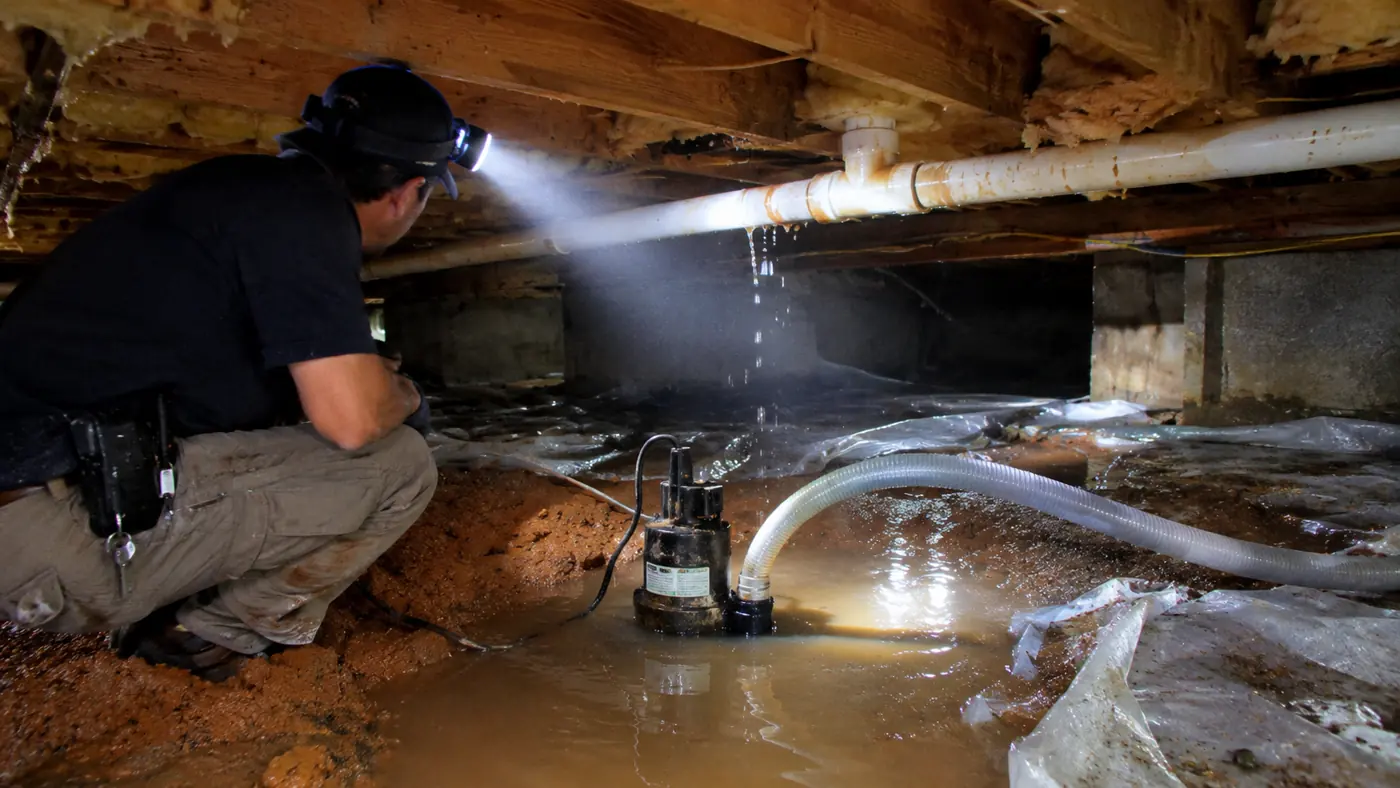
We use small submersible pumps with a discharge hose run well away from the foundation, then a wet vacuum to take up what the pump cannot reach. The crew works in a headlamp, in a tight space, often on mud. Before we start we check for electrical hazards: wiring in a crawlspace that is wet is a hazard, and if the water has reached outlets or the panel we shut off power first. We also check for ductwork that has been soaked, because wet duct insulation holds moisture and smell for a long time.
Choose this when
- Standing water or mud under the house.
- Wet insulation hanging down from the floor.
- A damp, earthy smell in the house that gets worse after rain.
- A sump pit in the crawlspace that failed.
Not the right fit
- Mold growth on joists: mold removal.
- Full basement flooding: flooded basement cleanup.
- You want a vapor barrier installed or the crawlspace encapsulated. That is a different job from cleanup.
Wet crawl space on red clay
Red clay behaves differently from sandy soil. It holds water, turns slick and sticky, and dries very slowly. After a pump-out the dirt floor can stay wet for days, and the vapor barrier, if there is one, may be holding a pool of water on top. We pull back or cut the barrier as needed to drain it, then dry the air and the surface with dehumidifiers sized for the crawlspace volume. Without that step, the water you pumped out is back as humidity within a week.
Crawl space drying and what we remove
Fiberglass insulation that has been soaked sags and does not dry well, so it usually comes out. Subfloor plywood and floor joists can often dry in place, but we measure first. If the floor above is hardwood, we also check it for cupping because crawlspace moisture comes up through it. After drying we tell you what the readings were and whether the space is still a risk for mold.
Cleanup is not encapsulation
Cleanup removes water and dries the space. Encapsulation is a construction project: a heavy vapor barrier, sealed vents, often a dehumidifier and sump. Both can be useful after a wet crawlspace, but they are different jobs from different trades, and one does not replace the other. We do the cleanup and drying side.
Piedmont clay and Kennesaw crawlspaces
Kennesaw's Piedmont clay, the many crawlspace houses, and the uneven ground around the mountain make crawlspaces one of our most common calls. Two other local points matter. First, crawlspace water lines run through unheated, vented space, so a hard freeze like December 2022 splits them. The Atlanta airport recorded 8°F that Christmas Eve, and Cobb County reported hundreds of homes and businesses with water damage, mostly noticed after the thaw. Second, summer humidity makes a wet crawlspace stay wet. If you are not sure the water is gone, a hygrometer in the crawlspace will tell you more than a flashlight.
Sources: USDA-NRCS, Cecil series; Atlanta News First, Dec. 24, 2022.
Why a crawlspace holds water on red clay
A crawlspace is a low spot with a dirt floor. Water that gets in has nowhere to drain.
What to do before we arrive
- Do not enter a crawlspace with standing water and live wiring. Turn the breaker off from a dry spot first.
- Shut off the water if a line is the source.
- Tell us how you reach the crawlspace: door, hatch or from inside the house.
- Note any soft spots in the floor above and any musty smell.
Crawlspace water removal cost
| Scope | Planning range, mitigation only |
|---|---|
| 800 sq ft crawlspace, clean water, found after 1–3 days | $3,750–$10,100 |
| 1,000 sq ft crawlspace, clean water, found after 1–3 days, wet insulation out | $4,650–$12,600 |
| Pump-out only, no drying | Quoted by the hour or by the job after a look |
The range is wide because crawlspaces vary more than any other room: clearance, depth of water, how much insulation is down, how far the discharge hose has to run. Encapsulation is not included. Planning ranges, not a quote. A written scope after an on-site look is the only real number. Call (678) 940-0778. Try the calculator with “crawlspace” selected.
Sources: Angi; Fixr; HomeAdvisor.
Crawl space questions
How do I know if my crawlspace has water?
Look for a musty smell in the house, wet insulation, a sagging vapor barrier, or damp ground. Use a flashlight from the access door after a storm. Do not crawl in if you see water near wiring.
Is it safe to go in myself?
Not if water is near wiring, if the space is tight, or if you cannot stand to be in dirty water. We have equipment and a plan for the hazards.
Will the water come back?
If the source is outside drainage, a high water table or a pipe, yes, unless it is fixed. We tell you what we see.
Do you remove mold in the crawlspace?
Yes, when it follows a water event. See the mold removal page for how containment and removal work.
Related services
Water on the floor right now? Call us. (678) 940-0778