
Flooded basement cleanup is pumping out the water, removing wet carpet and drywall that cannot be saved, drying the walls and slab, and finding out why the basement flooded so it does not repeat. Start within the first day to keep more of the finish.
When the NWS wrote up the September 2009 floods, it counted 79 river gauges above flood stage across north Georgia, and in the days after, basements all over the metro were full. Most flooded basements around Kennesaw are not from a flood like that. They come from a gutter spilling at the corner, a sump pump that quit in the middle of a storm, a water heater that let go, or a washing machine hose. The cleanup is the same: water out first, then drying.
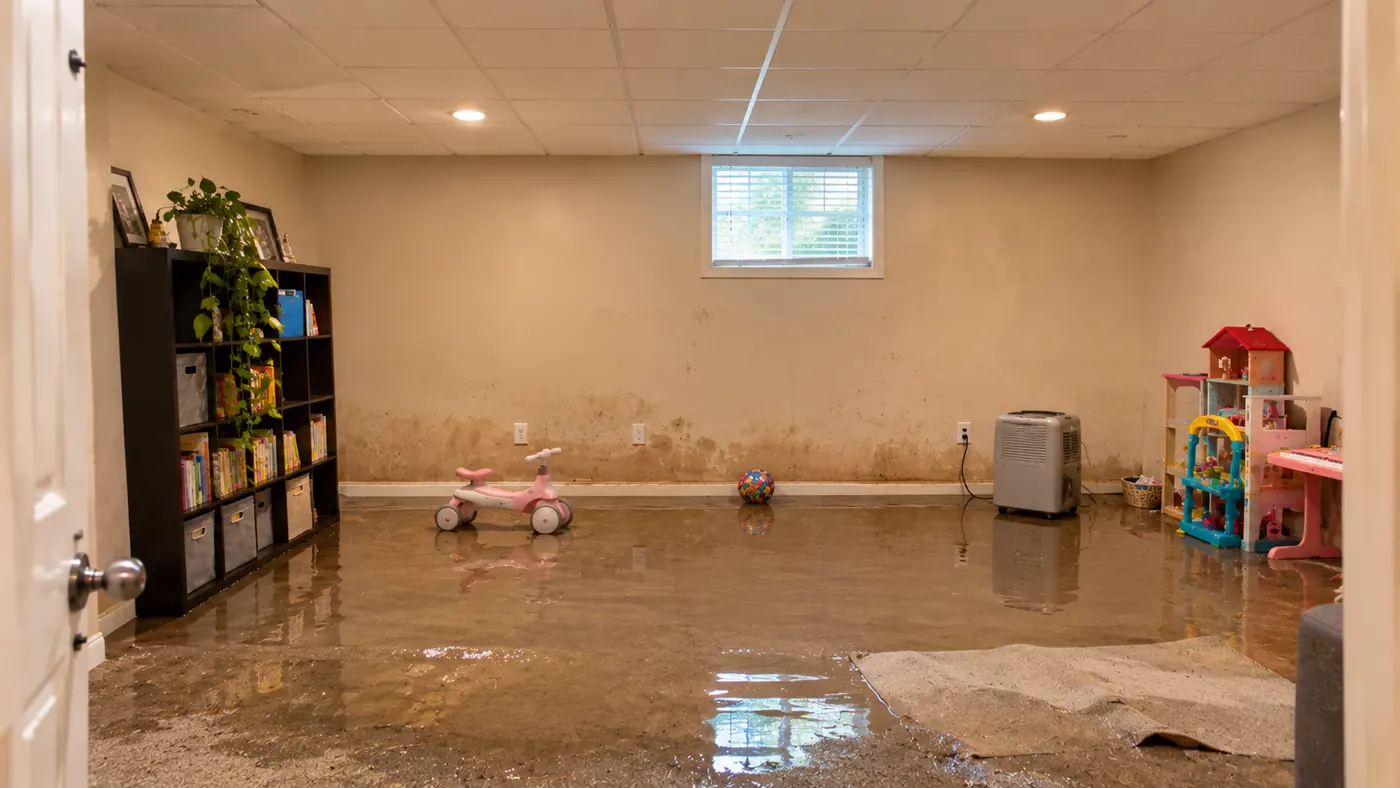
Basement water removal and the order we work in
- Make it safe: check for water near outlets and the panel, then shut off power to the wet area if you can reach the breaker dry.
- Pump out standing water, starting at the lowest point.
- Extract carpet and pad. Pull the pad, which almost never dries well, and either dry or remove the carpet depending on water type.
- Flood cut wet drywall and remove wet insulation.
- Set drying equipment and measure daily.
- Look for the source and tell you what we found.
Basement flooding after heavy rain
If it flooded only during a storm, the cause is nearly always outside: roof water dumped too close to the foundation, a yard sloped toward the house, a window well filling like a bucket, or groundwater pushing in through the wall-to-slab joint. We do not do grading or waterproofing, but we can tell you what the water pattern looks like and what to ask a drainage contractor to check.
Choose this when
- Water on the basement floor, wet carpet, or damp lower walls.
- A failed sump pump or a backed-up floor drain.
- Storm water through a window well or wall joint.
Not the right fit
- Sewage in the water: sewage backup cleanup.
- Only a crawlspace is wet: crawlspace water removal.
- Water from a burst pipe: burst pipe cleanup.
Finished basement water damage and what stays or goes
Finished basements have more at stake: carpet, pad, drywall, baseboard, insulation behind it, sometimes built-in cabinets and trim. The fastest way to lose all of it is to wait. Clean-water jobs caught early often keep the drywall above the two-foot line. Contaminated water or water that has wicked high usually means removing more.
| Material | Clean water, caught within a day | Gray or black water, or sat for days |
|---|---|---|
| Carpet pad | Removed | Removed |
| Carpet | Often extracted and dried | Removed |
| Drywall | Dried in place or flood cut at about 2 ft | Flood cut higher, removed |
| Insulation behind drywall | Often removed if wet | Removed |
| Hardwood or laminate | Dried, watched for cupping | Often removed |
| Concrete slab | Dried | Cleaned and treated |
Sump pump failure cleanup
Sump pumps fail in storms for boring reasons: the power went out, the float stuck, the pit was too small, the discharge line froze or clogged. If yours failed once, plan for it to happen again at the worst moment. A battery backup and a high-water alarm are the two cheap fixes plumbers and basement contractors usually recommend. We pump, dry and document. We do not install sumps.
Red clay and basement flooding in Kennesaw
Kennesaw's red clay is the main local factor. It drains slowly, so water stays against basement walls longer than in sandy soil. The second factor is slope. Kennesaw Mountain rises to 1,808 feet while the city sits near 1,089, so many lots have a downslope side where water collects against the wall. If your basement door or window wells face downhill, they are the first place we check.
Sources: NWS, 2009 flood anniversary; Kennesaw Mountain elevation; Kennesaw elevation.
How rain becomes a flooded basement
On Kennesaw's red clay the water has few places to go but toward the foundation.
Window wells
Fill with rain and leak at the frame. Clear debris and check the drain.
Floor-wall joint
Water seeps up along the edge of the slab where the wall meets the floor.
Sump pit
If the pump or its power fails, the pit overflows onto the floor.
Floor drain
A blocked or backed-up drain pushes water into the room. If it is dirty, see sewage backup cleanup.
What to do before we arrive
- Stay out of the water if it is near outlets, the panel or an extension cord. Turn off the breaker only from a dry spot.
- Do not go down stairs into deep water.
- Take photos of the water line before pumping.
- Call us with how deep it is and whether the sump is running.
What a flooded basement cleanup costs
| Scope | Planning range, mitigation only |
|---|---|
| 300 sq ft finished basement, clean supply line, found within the first day (extraction, carpet and pad out, flood cut under 2 ft, drying) | $1,650–$3,700 |
| 600 sq ft basement, gray water after a storm, found next day | $4,200–$10,450 |
| 500 sq ft unfinished basement, tile or slab floor, clean standing water | $2,100–$5,050 |
Planning ranges, not a quote. A written scope after an on-site look is the only real number. Call (678) 940-0778. Use the calculator to adjust for your square footage. Repairs are priced separately after drying.
Sources: Angi; Fixr; HomeAdvisor.
Flooded basement questions
Is my basement flood covered by insurance?
It depends on the cause. Standard homeowners policies often exclude rising groundwater and surface flooding and cover sudden internal sources like a burst pipe, and sump failure may need a separate endorsement. Read your policy or ask your agent.
Can I save my carpet?
If the water was clean and the carpet was extracted within a day or so, often yes. The pad is replaced. Gray or black water means the carpet goes.
How long before I can use the room?
Drying takes a few days. Rebuild takes longer. We give a timeline for the drying part after we see the room.
Do I need to leave the house?
Not for clean water. For sewage or heavy contamination we may ask you to stay out of the affected area.
Will it flood again?
If the source is not fixed, yes. We tell you what we see, and you can then talk to a drainage or plumbing contractor.
Related services
Water on the floor right now? Call us. (678) 940-0778